

Table of Contents
- Why Affordable Designer Inspired Perfume Oils Are Worth Trying
- Perfume Oils vs Alcohol Sprays: What Actually Changes on Your Skin
- How to Choose a Scent Profile That Works With Your Skin
- Long-Lasting Alcohol-Free Perfume Oils: What to Look For
- How to Apply Perfume Oil for Maximum Scent Projection
- Ingredients, Purity, and What Skin-Safe Really Means
- Cost, Quality, and the Dupe vs Counterfeit Question
- Frequently Asked Questions
Last Updated: September 30, 2026
Why Affordable Designer Inspired Perfume Oils Are Worth Trying
Affordable designer inspired perfume oils let you smell expensive without spending like it. Designer fragrances often cost over a hundred dollars a bottle, much of which pays for the name on the glass, not the scent. Perfume oils flip that equation by concentrating the fragrance and skipping the alcohol that dilutes most sprays.
Perfume Oils vs Alcohol Sprays: What Actually Changes on Your Skin
Perfume oils and alcohol sprays deliver scent differently. An alcohol-based spray is mostly alcohol, which evaporates quickly, so it hits fast and fades. An oil-based perfume skips the alcohol entirely, so the scent unfolds slowly and clings to skin.
The trade-offs matter:
- Projection: Sprays throw scent further; oils sit closer to the body.
- Longevity: Oils typically outlast sprays on skin because they evaporate more slowly.
- Skin feel: Alcohol can dry or irritate sensitive skin; pure oils are gentler.
- Intensity: Oils feel richer and warmer, since there is no alcohol sharpness.
How to Choose a Scent Profile That Works With Your Skin
Your skin chemistry decides how a fragrance smells on you, which is why two people can wear the same oil and get different results. Dry skin holds scent for less time; oilier skin amplifies and extends it.
A practical approach:
- Gourmand and warm scents (vanilla, amber, tonka) tend to last longest and suit cooler skin.
- Fresh and citrus profiles read bright but fade faster, so they reward reapplication.
- Woody and spicy notes sit in the middle and work across most skin types.
- Unisex fragrances built on musk or woods are the safest first buy if you are unsure.
Mapping Fragrance Notes: Top, Heart, and Base
Fragrance notes reveal themselves in stages. Top notes are the first impression, usually light and bright. Heart notes appear once the top fades, forming the core character. Base notes are the deep, long-lasting foundation that lingers for hours.
Long-Lasting Alcohol-Free Perfume Oils: What to Look For
Longevity in an alcohol-free perfume oil comes from four variables: fragrance concentration, carrier-oil weight, ingredient purity, and storage. Here is how to read each on a label.
1. Fragrance concentration (the biggest lever)
Perfume oil strength is usually described by the percentage of fragrance concentrate in the blend. Common ranges you will see:
- Perfume oil / parfum oil: roughly 15-30% concentrate. This is the strongest category and the one that behaves most like a true extrait.
- Eau de parfum (EDP): roughly 15-20% concentrate, usually in an alcohol base.
- Eau de toilette (EDT): roughly 5-15% concentrate.
- Eau de cologne (EDC): roughly 2-5% concentrate.
2. Carrier-oil weight (what holds the scent on skin)
Carrier oils are the unscented base that carries the fragrance. Their molecular weight determines how slowly they evaporate, and slower evaporation means longer wear:
- Jojoba oil, technically a liquid wax, closest to human sebum, absorbs slowly and is a common base for long-wear oils.
- Fractionated coconut oil, light, odorless, fast-absorbing; good for warm climates but can shorten wear.
- Sweet almond and apricot kernel oil, mid-weight, comfortable, moderate longevity.
- Castor and heavier seed oils, thick, slow-evaporating, often used in small amounts to anchor a blend.
3. Ingredient purity and safety standards
Three labels do real work here:
- Phthalate-free, phthalates are plasticizers historically used to extend fragrance in some commercial products; many consumers now avoid them. A phthalate-free claim is verifiable only if the maker lists it explicitly.
- Paraben-free, parabens are preservatives. Oil-based products with low water content often do not need them, so a paraben-free claim is usually easy to keep.
- IFRA-compliant, the International Fragrance Association publishes usage standards that limit or restrict certain fragrance materials based on skin-safety data. A maker who says their blends are IFRA-compliant is referencing a public, checkable framework rather than a marketing phrase.
None of these labels guarantees longer wear; they separate a transparent maker from one hiding behind the word "pure." If you have known sensitivities, patch-test on the inner forearm for 24 hours first.
4. Storage and shelf-life (the variable buyers ignore)
Even a perfectly blended oil degrades. Heat, light, and oxygen are the enemies:
- Heat accelerates oxidation and can turn a bright top note sour within months.
- UV light breaks down aromatic compounds; this is why amber and cobalt glass exist.
- Oxygen enters every time you open the bottle, so wide-mouth jars age faster than narrow roll-ons.
How to Apply Perfume Oil for Maximum Scent Projection
Most guides tell you to dab oil on your pulse points and stop there. That is the starting line, not the strategy. Projection from a perfume oil depends on three things: which applicator you use, where you place the oil relative to body heat, and what you layer it with. Get those right and a single roll-on can read across a room; get them wrong and even a strong oil stays invisible.
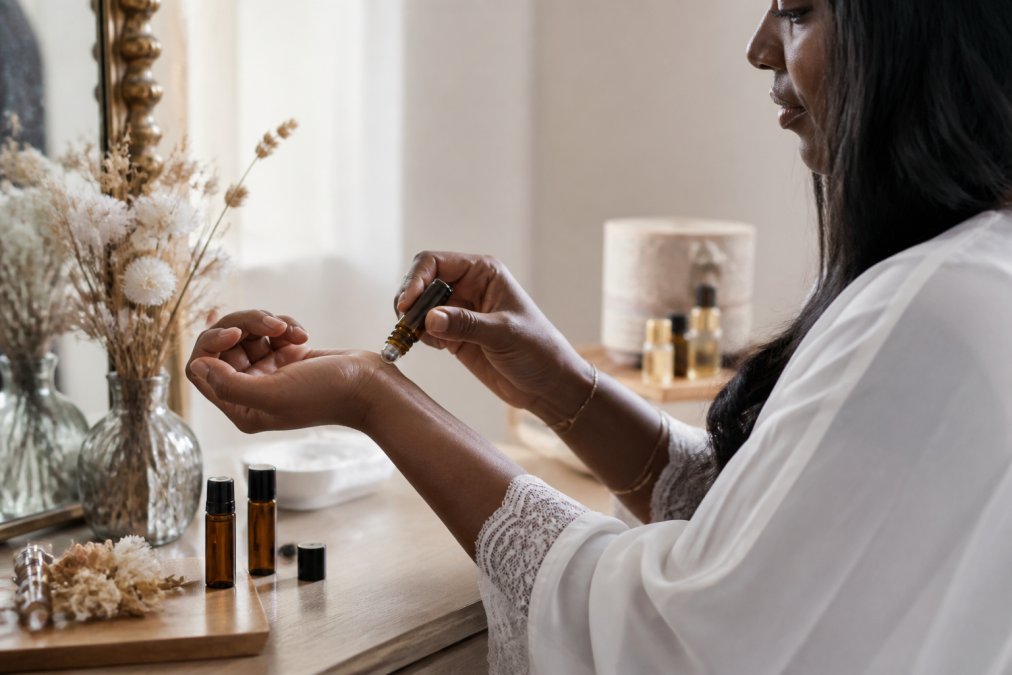
Roll-on vs dropper vs spray-oil hybrid: what each method actually does
Application format changes how much oil reaches your skin and how evenly it spreads, which changes projection more than most people realize.
| Method | How it delivers | Projection profile | Best for |
|---|---|---|---|
| Roll-on | Ball bearing deposits a thin, controlled line of oil | Close, steady, long-lasting | Pulse points, daily wear, travel |
| Dropper | You control the exact drop count | Variable, can be strong or subtle | Layering, blending, testing new scents |
| Spray-oil hybrid | Oil pushed through a fine mist nozzle | Wider surface coverage, more sillage | Hair, clothing, larger skin areas |
| Solid balm | Wax-and-oil base, applied with fingertips | Very close, intimate | Cold weather, sensitive skin, handbag carry |
The placement map: where heat does the work
Perfume oil does not project on its own, it needs body heat to lift the fragrance molecules off your skin. That is why placement matters more for oils than for alcohol sprays, which evaporate on their own.
High-heat zones, in rough order of warmth:
- Base of the throat / collarbone, strong heat, close to the nose, good for personal enjoyment.
- Inner wrists, moderate heat, easy to re-swipe, but constantly rubbed against surfaces.
- Behind the ears and nape of the neck, steady heat, good for sillage when you move your head.
- Inner elbows, moderate heat, less disturbed than wrists.
- Behind the knees, lower heat, but scent rises as you walk, which is why some wearers prefer it for evening.
Layering for projection without overloading
The fastest way to boost projection is not more oil in one spot, it is oil plus a compatible second layer. Three moves that work:
- Oil under a matching spray. Apply the oil first on pulse points, then mist a lighter alcohol spray of the same scent family over your clothing. The oil anchors the base; the spray adds lift.
- Oil over an unscented moisturizer. Hydrated skin holds fragrance longer because dry skin absorbs oil faster. Apply a fragrance-free lotion, let it set, then apply the oil.
- Oil on hair ends and fabric. Hair and cloth release scent slowly as you move, which extends sillage without adding skin irritation risk. Test on a small fabric area first, some oils can stain light colors.
A practical application routine
- Start on clean, moisturized skin. Hydration slows absorption and stretches wear time.
- Apply the heaviest layer (roll-on or dropper) to the throat, nape, or inner elbows.
- Press, do not rub, to keep the top notes intact.
- Add a light pass on hair ends or a scarf for movement-based sillage.
- Reapply mid-day to the same spots rather than adding new ones, layering on top of old oil can turn a scent muddy.
The takeaway: projection is a placement-and-format decision, not a volume decision. More oil in one spot mostly makes you nose-blind; smarter placement and a compatible second layer make the scent travel.
Ingredients, Purity, and What Skin-Safe Really Means
Skin-safe means an oil is free of the ingredients most likely to irritate, starting with alcohol and harsh fillers. Pure perfume oils rely on carrier oils and fragrance concentrate, nothing more. That shorter list is easier to trust, especially if you have reacted to a spray before.
Cost, Quality, and the Dupe vs Counterfeit Question
| What You Are Buying | What It Is | Cost Level | Risk |
|---|---|---|---|
| Designer original | Authentic branded bottle | Highest | Low |
| Dupe / inspired oil | Own blend, similar impression | Lowest | Low |
| Counterfeit | Fake branded product | Variable | High |
Quality in a dupe comes down to the blend, not the label. A well-made oil smells close to the original and lasts; a cheap knockoff smells thin and disappears fast.
Frequently Asked Questions
What are the benefits of using perfume oils over alcohol-based sprays?
Perfume oils skip the alcohol that evaporates quickly from sprays, so the scent sits closer to your skin and releases more slowly over several hours. They tend to suit people with sensitive or dry skin because there is no drying alcohol. You also get a stronger concentration of fragrance notes per drop, which means a small roll-on bottle can last as long as a much larger spray bottle.
Are designer-inspired perfume oils safe for sensitive skin?
Alcohol-free formulas remove one common irritant, but sensitivity varies by person. Check the ingredient list for fillers, and patch-test any new oil on your inner forearm for 24 hours before wearing it widely. If a formula lists only fragrance and a carrier oil with no drying alcohols, it is generally a gentler starting point than an alcohol spray.
How long do affordable designer inspired perfume oils typically last on the skin?
Most quality perfume oils last four to eight hours depending on your skin type, the concentration, and where you apply them. Oily skin holds scent longer than dry skin. Applying to pulse points and moisturising first can stretch wear time. Base notes like vanilla, amber, and musk tend to linger well past the top notes.
What is the difference between a perfume oil dupe and a counterfeit fragrance?
A dupe is a legally made fragrance that captures a similar scent profile using its own blend and packaging, without claiming to be the original brand. A counterfeit copies the trademark, bottle, and branding to pass as the real product. Dupes are the honest, affordable route; counterfeits are illegal and often use unknown ingredients.